Home

  • New Year’s Day 2024

    I enter the new year bemused by the reporting of global celebrations as we leave 2023 with wars, cost of living crises, and much uncertainty with forthcoming elections. The increasing commercialisation of bank holidays concerns me as there is always such a build up to Christmas Day with shoppers filling high streets…and then again on Boxing Day. It defies logic. Personally, I relish the opportunity to hole up indoors and idle away the darkest time of year with family, friends, food and a film or three. This year, I have been fortunate to be well supported by such people and things while I recover from a foot operation a couple of weeks before Christmas. 

    My aim this year is to find an agent for myself and to promote my friend Iryna Ilnytska in her singing career. She deserves to be heard on a global scale.

    January is traditionally a time for resolutions and new beginnings but I feel Easter and spring are more conducive to this approach. January is a proper winter month when soups and pies can be enjoyed after brisk winter walks in the fresh air, and sunshine when available. It is a time to enjoy the massive Orion constellation with naked-eye glimpses of the fuzzy blob that is the star forming region (can be found just below the 3 belt stars). 

    Wishing you a hopeful and healthy 2024

  • w/e 17 September

    The week began and ended with a concert to raise funds for Ukraine and a school in Uganda.  I described the earlier concert in my previous notes, with the latter a reprise of the first.  And no less delightful.  In fact, more so, as the pianist was able to use a grand piano rather than his portable electronic piano as last time.  Again, the music and singing were sublime and well-attended by the people of Honiton.  This time I was able to take along some little sponge cakes, covered with blue and yellow icing with tiny Ukrainian flags on top. 

         In the middle of the week was a trip to see my daughter and be of help with application advice, household chores…and aiding with a trip to the vets for one of the Bunnies.  It was lovely to spend time together.  We enjoyed a late walk after dinner into some woods where we heard a nearby owl. 

         Upon my return, I was surprised to pass Stonehenge for once devoid of people ever-circling it.  Each time I pass by there seems an endless queue of people admiring it.  Disturbingly, the roadworks to widen part of the road further up the route towards the west country were in full swing.  Thankfully, the proposal to build a tunnel by Stonehenge has not been approved.  Apart from the aesthetic excitement of seeing the circle of stones appear on the horizon, there are just so many burial chambers around, it would surely be sacrilegious to disturb them.

  • Exeter Library Stack

    Following on from my epic reading marathon of Henry Williamson’s awesome saga spanning the social changes from 1880 to 1940s, Jez from Exeter Library has said some kind words about the review I completed and the full version of my guest blog within his ‘Sleuthing in the Stacks’ blog is available on the Library website (link to follow) with his introduction below:

    Here’s a guest post from friend of the library Karen Hedges (whose website, including blog, you can find here). Karen works tirelessly to promote and further the educational work of the Norman Lockyer observatory above Sidmouth, which featured in a previous post on Norman and Lady Lockyer. Karen has also put on a number of excellent illustrated science talks in St Thomas Library, with a particular focus on the Moon. Here, however, she focusses her attention on a major saga by a Devon-based author which she got swept up in, which takes its protagonist through the turbulent history of the first half of the twentieth century. As Karen says, it’s a real reading marathon, but one which she has completed. So here she is, reporting back from the finishing line for Sleuthing in the Stacks.

    Thank you, Jez!

  • Reflections w/e 10 September 2023

         I remember 10 September 2001 distinctly.  It was a Monday and I was enjoying gardening in the warm sunshine.  I had a phone conversation with my friend, Ulrike.  Life felt good.  How all that changed the very next day with the now so-called 9/11 terrorist attacks on the Twin Towers in New York.  And, shortly afterwards, we had news of the Relocation.

         Today, by coincidence, is another life-affirming day when I drove into Exeter to enjoy a lunchtime concert given by my friend, Iryna, and a pianist in aid of the volunteers in Ukraine and a school in Africa.  The music was exquisite and a mix of sombre and joyful. 

         The heatwave continues with highs of 29 degrees today.  The humidity feels relentless.  Last week, we were glad of the good weather as we enjoyed a few days break in Cornwall.  It was perfect.  Hot, but perfect with deep blue skies and deep blue seas with white surf in stark contrast.

         The week of hot weather was rounded off with a delicious swim in the early evening with the mist swirling around the headland.  The sun was a pale disc with its power depleted.  The water was pleasant, with no need to rush to grab a towel on emerging.

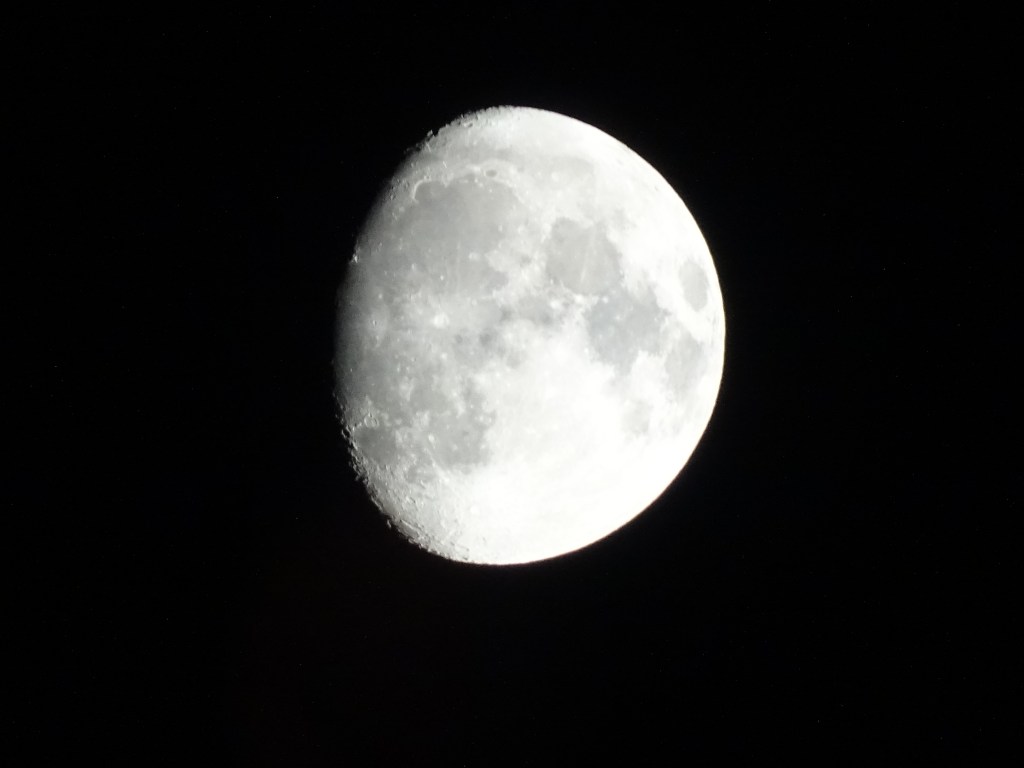
  • There has been a lot of fuss in the press regarding the blue supermoon…and rightly so! The Moon is a fascinating object and an easy objec to get anyone interested in space and astronomy. I was fortunate to be interviewed on Radio Devon which gave me an opportunity of explaining the phenomenon. When there are two full moons in a month, the second one is called ‘blue’…origins of this are disputed, and the term is used as a catch all for anything rare. Two full moons in a month are not actually that rare but a blue supermoon is. A supermoon occurs when the moon is at its closest to Earth or perigee, and when it coincides with being low on the horizon, looms very large in the sky. It is the same size as always, but appears larger due to perspective and the extra brightness.

    February can never contain a blue moon because the time it takes the Moon to make an orbit of Earth and for it to complete a cycle of its phases are both longer than there are days in that month.

    The Moon is full because it is directly opposite the sun, so it is fun to try to observe the sunset and the full Moon at the same time. And challenging due to the vagaries of the weather.

  • Book Review of Henry Williamson’s Chronicle of Ancient Sunlight

    This ambitious project has taken me a year to complete, and then not entirely as I skipped a couple of volumes in order to complete the reading and review. It was through Jez at Exeter Central Library that I came across this series and it deserves much wider recognition.

    Here it is:

    Book Review of Henry Williamson’s series entitled ‘A chronicle of ancient sunlight’ – in a nutshell, this series is something I wish I had discovered earlier.

    Exeter Library had a display of books of local interest from the Stack and I was intrigued by ‘The Dark Lantern’ by Henry Williamson.  I had not known he had written books other than Tarka and Salar.  As I turned the pages, I was transfixed by the prose – not a word wasted, every word, every phrase to be savoured.  Why had I not known of these books?  The old books have proved an unexpected delight and convey the huge social change in such an interesting and evocative way.  There was even a Henry Williamson Society.  One day perhaps I may join.  His books come across as semi-autobiographical and describe Kent and Devon, both areas well known to me.  It took me a long time to read the first book, or rather savour it as I was entranced by the prose, the insights into personal behaviour and the general descriptions of life, nature and places.  The characters spring from the book and the narration encourages sympathy for the main characters, while you want to scream at each of them and tell them to speak honestly to each other.  His descriptions of human behaviour emulate the detail of his animal books.  The descriptions of the minutiae of life are detailed yet never boring.  A treasure trove indeed as there are 8 in the series. 

    In ‘A chronicle of ancient sunlight’, Henry Williamson treats us to a wonderful journey through the adventures and misadventures of Richard Maddison and his family against a background of stupendous social change.  The detail is on a par with Dickens but, to my mind, his writing is more tightly written with not a word too many.  The characters are totally absorbing; and relationships and growing up are explored in such a way that you find yourself nodding in agreement or with sympathy for the character.  Sheer brilliance.

    The Dark Lantern

         A young man’s view of the world with late Victorian constraints.  Williamson evokes the pain of love and the intricacies of relationships so beautifully and with such empathy.  This was a hugely enjoyable read.

    Donkey Boy

         The narrative captures the thoughts and feelings of a young boy, or indeed girl, with a freshness and accuracy that is intimate and perceptive.

    The Young Philip Maddison

         The narrative moves to Richard’s son, Philip, and shows the similarities between father and son.  Imperceptibly the narration moves from that of a child to a young adult, conveying the inner life of a child’s mind.

    How Dear is Life

         A gritty exploration of life on the cusp of the First World War, with the excitement of going to war, the worry of war affecting an already struggling Britain.  Very dark tone, different from the others so far.  Descriptions of scenes my grandfather would have seen. The narrative has a very different feel from the previous books I have read.  It is a dark book and conveys the futility of fighting and the contradiction of fighting for peace.  There is very much a pacifist strand running through this book.

    A Fox under my Cloak

         Immediately we are taken onto the battlefields of the Somme and, along with Philip, feel that the old days of the scouts are such a long time ago.  I am finding the blow-by-blow account of the war a bit heavy going.  The descriptions of life in the trenches and the reality of war make for grim reading and I have to confess to skim reading some of this book.  Williamson certainly makes you feel the horrors of war and Philip’s distress.  Not an easy read.

    The Golden Virgin

         I had put off reading this book but what a mistake…the first few pages were a delight with the narrative voice changing to Philip’s sister, with her views on past events.  I was struck by a reference on page 38 to the ‘great chemical concern of Brunner, Mond, and Company’ by which it was apparent how thorough was Williamson’s research.  As a member of the Norman Lockyer Observatory, I had recently learned that the Mond Dome was named in honour of Robert Mond, a friend of Lockyer’s and founder of ICI.  The name jumped out at me, and I thought, “I know about this!”.  

         The detail of tunnelling and the hardships of the war in the Somme are graphic.  Within this volume are hints of anti-war feeling and mention of conscientious objectors. 

         On page 221 Williamson evocatively writes ‘the roll of the Earth from darkness into light was brief’, which is an astronomically accurate depiction of the changing seasons on Earth. 

         During his descriptions of the Battle of the Somme, Williamson has a touching scene in which a British priest shows compassion for an injured Bavarian.  I don’t think many would disagree about the waste and destruction of war.

         Williamson is amazingly perceptive: I read the sentence, ‘It was sad that the world seen from the safety of bed had already vanished.’ with a degree of empathy and understanding as I had been confined to bed for a few weeks following an operation on my foot.  It had been relaxing and refreshing to have a break from everyday life.  Interestingly, that experience definitely helped with the confinements of lockdown. 

         His writing is vibrant and compelling, albeit on the particularly gloomier side in this volume when he suggests “we’re all on a voyage of death”.  This volume has really established the story in the 20th century with references to the old Victorian ways with which the story began.  Imperceptibly, the narrative changed to the second of three generations in this chronicle.  There are references to the ancient sunlight which is the over-arching title of the series.  This book has strong overtones of longing for lost times.  A haunting volume.

    Love and the Loveless

         The relentless story of the Somme continues.  Philip shows his sensitive and caring side with respect to ‘his’ men and the ‘donks’.  The graphic descriptions of what the horses and mules went through resonate with me as my grandfather was in the Royal Horse Artillery in the Somme.

         And the awesome phrases continue…”That night, under the tarpaulin roof of the mess, the levels of initialled whiskey bottles were lowered.”  What a gem!

         Interspersed amongst the detailed minutiae of life on the battlefield, are glimpses of Philip’s longing for home, for the country, for life as it was before.  He continues to notice the natural world, and the changing seasons.  He also notices that women are doing more and more work such as on buses and canals.

         There is mention of a United States of Europe.  Comparison is made with the fighting between Greek states.

         And still the brilliant writing continues…”Giant finger-flashes were playing the piano of hell behind the distant Gheluvelt plateau.”  And, just when you think it can’t get any bleaker…the phrase “even the worms were dead” appears as the descriptions of the Somme continue in their detailed bleakness.

         I notice that my reviews so far have become longer in line with the increasing complexity of the novels and my increasing admiration for Henry Williamson.

         For the sake of actually completing a review of this series, I shall concentrate on three more books in the series which seem to cover key moments in Philip’s life and in history.  At a later date, I envisage returning to the series to read those books I have left out.  (Author’s note:  I started reading the series in August 2022 and am writing this in August 2023 and feel I have completed a marathon!)

    The Phoenix Generation

         Lots of observations about the changing social structure and an interesting comment about encouraging people to retire at 60 in order to release jobs for those who need them most…!  This book has a different feel about it as well as containing hints of stories to come, for instance, Salar the Salmon.  I tried reading that book but found the descriptions of the salmon too heartbreaking.  I will have another go one day!

         And so, Williamson’s writing genius continues with phrases such as “split scones daubed with cream and jam.” 

         Halfway through and the tone is becoming darker with political overtones and mention of Hitler…I am disturbed by the main character’s tendency towards having affairs which doesn’t fit with his earlier lifestyle.  I so wish I had discovered this series earlier in life.  However, I am keen to finish most of the series in order to complete a review for Exeter Library 😊 

    A Solitary War

         Somewhat disturbingly, this book contains a dedication to Diana and Oswald Mosley.

         But, oh dear, I was hoping to skim through this one in order to help finish the project…Williamson continues the high standard of prose and has wowed me on the first page already with his insightful observations of behaviour and speech in children, and the situation in Europe. 

         ‘”I don’t want to go to beastly old school either, so I think I’ll leave, too,” cried David.  And, Jonathan, the youngest, tried to repeat what David had said, but got confused, and exploded in a sudden shout.’

         About Europe, he writes that Britain’s policy had been to ‘divide and rule’, to prevent any nation trying to create a United States of Europe.  This echoes what I learned during my studies of European economic and political geography and is pertinent particularly at the moment with the resignation of Boris Johnson, who oversaw the department of Britain from ‘Europe’ in 2019/2020.  There is still much discussion over the fallout from Brexit.

         And, this book covers the beginning of the second world war.  A book to read carefully!

         There is a great sense of war-weariness and comments regarding the state of the economy, a united Europe, and the phoney war.  Hints of Jewish issues, Hitler, and feminism.  There are many references to the overarching theme of ancient light and shadows.  As an amateur astronomer, I was taken by his descriptions of the night sky, particularly the detailed directions to Polaris (“6 lengths from the coulter of the Plough”).  Although a member of the Imperial Socialist Party, it is difficult to ascertain where his true loyalties actually lie; Phillip’s main grievance is against the financial institutions.  He is pro-European and pro-Hitler, but as the war continues, he describes Hitler as being forced to act, with changes to his personality.  Farming is dear to his heart and Phillip is concerned with all farming issues, and the crisis the war brings to it.

    *****

         Finally, after a week’s holiday in Scotland, I read the final book in the chronicle, with a feeling of regret that I had not discovered these books earlier in my life.

    The Gale of the World

         Williamson’s magnificent writing shows no sign of letting up with such wonderful phrases as “summer clouds smouldering in an Atlantic sunset” and “Antares, most passionate of summer stars, blushes above the southern horizon”(Antares is the red alpha star in Scorpius).

         And again, this wonderful gem, ‘Trays of self-cremating cigarette stubs,’.  Awesome. 

         In this book, we return to the first character, Richard, as he lies in a nursing home, old and incontinent, still full of dreams and distant from his own family.  The title is a reference to the turbulent war years and massive social change as Philip remarks to his friend that “all of us now living have been ‘caught in the gale of the world’”…as indeed have all of us that have lived through the Pandemic.  There is a fair amount of retrospective thinking as Philip comes to terms with the death of his father and the effect his family and upbringing have had on his personality.  And yet, there are gems of light and hope in this volume, such as the phrase, “True love is like sunlight; it casts no shadow on the soul.”

         Disturbingly, this book also contains a reference to a dominant concern of our times, that of climate change.  Williamson notes that “The old British weather is passing away with the Empire…the polar ice-cap is melting…”.

         Throughout this book are sprinkled references to light, sunlight, and lanterns.  The tone is wistful and there is a superb reference to people and places of times past with the magnificent phrase, “…for that they were of Time lost, yet waiting to be brought back from ancient sunlight.”  And, almost imperceptibly, in the background there continue to be mentions of the massive social changes taking place.

    *****

         I include here, as a finale to my review, a quote from the Henry Williamson Society’s website:

    There are so many threads drawn together within this final novel, and so many strange scenarios presented within the plot, that the reader can feel an overwhelming confusion. But once the essentials are grasped the complexities dissolve into clearer pattern, and as the looming sense of doom resolves itself by coming full circle, creating a perfect whole, we are left with a powerful sense of satisfaction that all has ended well.

    *****

         Throughout all of the books, Williamson’s analogies are second to none and too prolific to mention many.  For example, ‘guns, painted in colours of decaying cabbages…’, the waning moon as a ‘decaying orb’.

         And so, I end my review of most of the books in this amazing series which has taken me on an intense journey from the end of the 19th century through to the war years of the 20th.  I really wish I had discovered this series sooner; I think it would take several decades to truly appreciate and understand it all.  Having now read most of the series, I want to return to the beginning and read the whole again with greater awareness.  Henry Williamson’s writing is awesome, and he deserves wider recognition.  Thank you, Jez of Exeter Library!

    August 2023

  • Honiton Revisited – a fresh (er…no I just missed a month!) series of items for publication on my website blog

    w/e 23 July 2023 (posted after the August one…;-))

         Hot Penny Day.  Well, the last time I attended this annual event in Honiton was on a wet day and when life was not so good…and I remember thinking, “what on earth am I doing here?”  Since then, there have been many changes, and this year saw a return to living in Honiton which was like slipping back into a comfy armchair.  I have been welcomed by old friends with the years falling away.  To be honest, it is not as long as it seems due to the ‘lost’ years of the Pandemic when no one went anywhere.  And I embraced the joyous melee that constitutes the Hot Penny ceremony when the crowd are thrown not-so-hot pennies and loudly repeat the phrases bellowed out by the Town Crier: Ye glove is up, let no man be arrested until the glove is taken down, let the fair begin…with each phrase repeated three times by the Town Crier and then by the crowd.  I have to say those who were throwing the pennies looked as delighted and happy as those scrabbling to gain some.  It was madness!  The frenzy increased at each stopping point.  The coins used to be thrown from a series of public houses, but this year some were thrown from a shop window.  I was pleased to pick up a few and a bit disturbed when the side of a coin caught my forehead.  It hurt.  Nevertheless, swept on by the growing tide of people, I made it to the Volunteer Inn for the final throwing before the Big Glove, atop a beautiful flower-garlanded pole, was set in place before the pub to signify the commencement of fair week.  Every year this pole is decorated by the Town Crier himself.

         Seemingly hot on the heels of this event, came the annual Charter Day when Honiton celebrates the granting of its Marker Charter back in 1257.  I walked down after an early lunch to be rewarded by some elegant Tudor dancing by dancers wearing beautiful costumes and robes.  The latter reminded me of the late Queen’s dresses I had seen in Holyrood Palace, which were designed to move in a flowing manner, much more like robes than dresses.  I took a walk around the many local and charity stalls before heading back up the hill in the now very warm sunshine to home and a cup of tea.  I was also warm with the feeling of happiness of being back home in Honiton.

         Sadly, as the town celebrates the granting of a market charter, the old cattle market is being turned into retirement flats.  It was not that many years ago that it was still in use for livestock.  Thankfully, local butchers survive selling meat from many local farms.

  • w/e 6 August 2023

         This week I took a trip into the city of Exeter to catch up with a friend and to return a library book.  I do not miss the roughness of Sidwell Street at all.  Exeter was noisy, busy and grubby.  The central library is a jewel though and my friend and I enjoyed a chat over a pot of tea in the nice café.

         And then it was off to another annual event, this time in the pouring rain and somewhat chilly air.  We walked down to the High Street where we boarded a free shuttle bus which took us down the A30 to a muddy field for the Honiton Agricultural Show.  We squidged through the mud between various stalls, some agricultural, many financial, and many local groups and charities.  It was well into the afternoon before we came across the hardy souls from the Observatory standing by their modest gazebo and a couple of telescopes.

         One of the highlights was a delightful Sheep Show, the sheep displaying their individual characters as they took their place on the display podium.  Sheep are funny!  There were high class dairy cows, huge shires, and the most amazing horse riders performing tricks such as running alongside the horse then jumping back on and interweaving at speed.

         The week was rounded off with a trip to Babbacombe to enjoy the 50th anniversary concert by Showaddywaddy.  I rocked.  Everyone rocked.  Babbacombe was quite nice too.  Tired but happy, we had a quiet outing to the world as a garden planting at Plant World on the way home on Sunday.

  • May Reflection

         The first of the month was actually on the Bank Holiday Monday or ‘May Day’ as it used to be called.  Not sure when it stopped being called May Day.  At primary school we were fortunate to have a maypole around which we danced on the warm spring grass.  It is one of my more delightful memories of schooldays.  The modern May Day seems to have connotations of Communism and military marches.  The old May Day evolved from the Celtic festival of Beltane celebrated on May 1st, midway between the spring equinox and the summer solstice, when dancing took place.

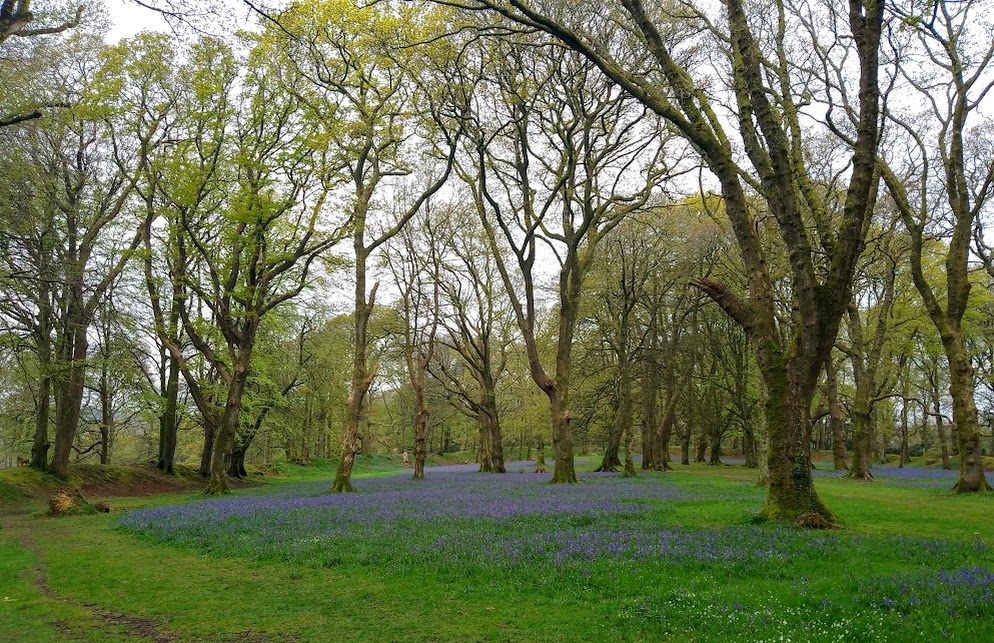
         This month saw the annual visit to Blackbury Camp to enjoy and admire the splendour of the bluebells amongst the magnificent beech trees.  I took Mum on a perfect spring day when the bluebells were just out and at their finest, before  heavy rain squashed some of their beauty.  Sturdy plants that they are, they recovered to continue to give much pleasure, and were still splendid when I took Roy a few days’ later.  Many more photographs were taken.

         The following Monday saw a second Bank Holiday Monday which was held in honour of the new King’s Coronation on the preceding Saturday.  Along with most the nation, those who were not lining the Mall, spent the day glued to the TV set, eating special food and becoming increasingly in awe of the proceedings.  Somehow, the event combined majesty and humility and it was ‘shiver-down-the-spine’ time when the King to be emerged from the screen where the anointing had been done privately.  He appeared incredibly vulnerable with very few robes and just a plain white gown on.  Then the layering up of robes and the handing over of the symbols of State began until the King emerged in all his glory.  Words cannot really describe the absolute sense of holiness and awe that filled me during this time.  Charles really was transformed from Prince to King before our eyes.

         The last Monday in the month was officially Spring Bank Holiday, having displaced Whit Monday back in the 1970s, although it was known as Whit Monday for a while longer than that.  So, Whitsun has become submerged due to formalising the bank holiday for the last weekend of the month rather than have the holiday in line with the actual number of days since Easter.  Whitsun or Pentecost is the day that the Holy Spirit appeared to the Disciples, on the 7th Sunday after Easter.  Even in these somewhat secular times, I feel something is being lost when the reason for the holiday is not actively remembered, and celebrated.  It becomes just another day off.

         However, the sun aspect of Whitsun was very much in evidence with day after day of glorious sunshine (the gardens and reservoirs need the rain but it was wonderful for the children to have a sunshine break at half term) which also led to gloriously clear evenings.  For the first time for years, I was able to make daily observations of the Moon, noting its changing position and make sketches of its phase.  I was then able to see the pattern of its orbit and actually prove that from that first very thin crescent to First Quarter, it does make an angle of 90 degrees. 

         The month was rounded off nicely with a meal in Topsham followed by enjoying watching Morris dancers and a tap dancing display, with a nearly full Moon overhead.  A real summer’s evening on the last day of the month.

    Karen Hedges

    May 2023

  • April Reflections

    With Easter falling towards the beginning of this month, the month began with a hefty amount of baking.  I tried again to make a traditional Greek Easter loaf which involves plaiting strands of dough.  It was a little more successful than a previous attempt, but not by much.  The pretty boiled eggs placed within it looked great though.  Then there was the annual baking of Hot Cross Buns.  Just bread, sugar, and currants…slathered with butter.

    A walk down the Lane delighted with some early bluebells and early signs of late summer with Lords and Ladies beginning to unfurl.  Countless birds flew in and out of the trees, following our progress.

    Strangely, now that I am really semi-retired, the things I was looking forward to, do not seem so important now and I am beginning to relish a growing sense of freedom.  Freedom to write more stories, visit friends and enjoy outings and walks.  I thought I would have a clean and tidy house once I retired but there is always something cropping up although we are decluttering slowly now that we have downsized.  I still like having a job, a paid job, as I feel valued, and it keeps me in touch with everyday life.  I enjoy the random contacts with people and ad hoc things that happen when you have to go out and about.  Also, helping people with maths and English, particularly maths, is rewarding.  I am also busy with the monthly radio pods and occasional talks.

    I am also back to being more involved with the Norman Lockyer Observatory which I love.  It seems almost inevitable that I begin my journey to becoming a director with the still needed improvements to communications high on the agenda.  I am organising a group visit to Exeter library to view the Lady Lockyer bequest which Jez introduced to me on a tour of the Stack.

    Swallows were sighted during the last week of the month, signalling that summer is on the way.  A sea swim ended the month.  I was hoping to have one on 1st April, but it was much too cold.  Today, the last day of the month, the conditions were ideal – high humidity, tide just in, air temperature above 12 degrees.  It was lush!  The water was not as cold as I had imagined.  A super end to the month!